1.0 freezes the public API. Upgrading from 0.3 starts with one install and a few import lines.
01 / Try it
One install and one import line.
npm install [email protected] \react-router@^7.18.2
// beforeimport { split, Link } from "catalyst-core"// afterimport { split } from "catalyst-core"import { Link } from "react-router"
Full guide: upgrading from 0.3.x to 1.0.0.
02 / What's new
Stable, at last.
The API, frozen
The root entry exports exactly eight names: RouterDataProvider, useCurrentRouteData, useRouterData, MetaTag, split, hydrationReady, Head and Body. A removed name fails at build time instead of resolving to undefined.
 @mayansharma#446
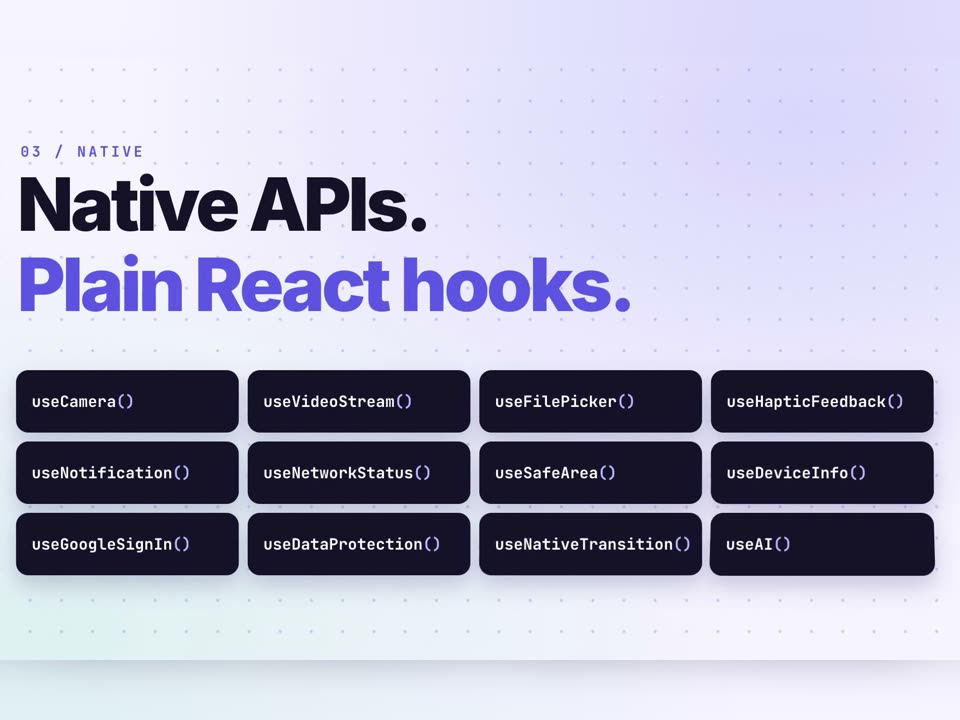
Native hooks, one contract
Every native hook uses the same keys: loading, data, error, and execute where a hook wraps one operation. The change is additive, and the older names stay as aliases until 2.0.
@mayansharma#447Every failure has a code
Build, native and runtime errors come from one registry. Each carries a code, a suggested action and a docs link, and hook errors are CatalystError values you can compare against ERROR_CODES.
 @mayankmahavar1mg#381
03 / Goodbye, hello
Goodbye export * from 'react-router', hello react-router@^7.18.2.
catalyst-core no longer re-exports React Router. It is a peer dependency, so import router names from react-router directly. The server checks the installed version at startup and exits with a clear error if it is missing or out of range.
@mayansharma#44604 / Also fixed
Ready for production.
- The server merges
config.jsonintoprocess.envinstead of replacing it.@mayankmahavar1mg#490 buildApp:androidno longer hangs after the emulator boots.@mayankmahavar1mg#491- iOS builds find DeviceHub.app on Xcode 27.@mayankmahavar1mg#486
- iOS builds default
cachePatternto an empty list when it is not set.@mayankmahavar1mg#488 - The MCP server finds the installed
catalyst-corepackage instead of the app that uses it.@mayankmahavar1mg#489 - The webpack-era config keys are no longer required or read. Remove them from
config/config.json.@mayansharma#476 - The app's module aliases win everywhere, so one import resolves the same way across a build.@mayansharma#445
Thank you.
Catalyst 1.0.0 was built by these people.
Questions or ideas? Find us on Discord, X and GitHub Discussions.
Full release notes
This release freezes the public API. The root entry of catalyst-core now exports exactly eight names and nothing else: RouterDataProvider, useCurrentRouteData, useRouterData, MetaTag, split, hydrationReady, Head, and Body. Anything previously reachable through the root entry but not in that list is no longer public. Applications that import a removed name will fail at build time rather than silently resolving to undefined.
React Router is no longer re-exported
catalyst-core used to re-export the whole of React Router from its root entry, so Link, Outlet, RouterProvider, useParams, useNavigate and every other router name could be imported from catalyst-core. That re-export is gone.
React Router is now a peer dependency (^7.18.2). Install it in the application:
npm install react-router@^7.18.2
Then import router names from react-router directly. An import line that mixed both sources splits into two:
// beforeimport { useCurrentRouteData, useParams, Link } from "catalyst-core"// afterimport { useCurrentRouteData } from "catalyst-core"import { useParams, Link } from "react-router"
One exception: client/index.js imports RouterProvider from react-router/dom, not from react-router. The react-router/dom build passes React DOM's flushSync into the router, which view transitions and flushSync navigations depend on. The react-router export renders the same tree but silently skips that.
Because the version is now declared by the application, npm will report a peer dependency conflict if the installed React Router major does not satisfy ^7.18.2. The server also verifies the resolved version at startup and exits with a clear error if React Router is missing or outside the supported range.
Removed export paths
catalyst-core/caching— removed. The caching feature was withdrawn and has no replacement.catalyst-core/document— removed. ImportHeadandBodyfrom thecatalyst-coreroot entry instead.
No default export from the root entry
split was previously exported both as a named export and as the default. The default export is gone; use the named one.
// beforeimport split from "catalyst-core"// afterimport { split } from "catalyst-core"
Names that are no longer public
These were reachable from the root entry and are now internal: RouterContext, serverDataFetcher, mergeHeadElements, deleteHeadTagsByDataAttribute, getMetaData, and useNavigateWithTransition. In addition, sanitizeFilePickerOptions is no longer exported from catalyst-core/hooks. None of these have a supported replacement. If an application depends on one of them, open an issue describing the use case before upgrading.
Native hooks: canonical keys
The native hooks now agree on one set of key names. Every change in this section is additive: no key that a hook returned before has been removed or repointed, so existing components keep working.
Several hooks were missing keys that the rest of the surface already had. useNotificationPermission gained loading, data, error, isNative, and isWeb, and it now reports permission failures as a standard error object instead of only logging them. useCameraPermission gained loading, data, error, execute, isNative, and isWeb on the same pattern. useDeviceInfo gained data alongside its existing deviceInfo. useNativeTransition gained loading alongside transitioning. The SSR stub returned by useAI reported isWeb: false, which was wrong on both counts; it now reports isWeb: true.
Where a hook had two names for one value, the shorter one is canonical and the older one is a deprecated alias that will be removed at 2.0: loading over isLoading and transitioning, data over deviceInfo and permission, and execute over request.
Hooks fall into three categories, and the category decides whether a hook has execute. A hook that wraps a single native operation exposes it as execute plus a domain-specific alias — takePhoto, pickFile, openFile, signIn, trigger, request. A hook that wraps several distinct operations has no single action to name, so its named functions are the API and it has no execute at all: useVideoStream, useDataProtection, and useNativeTransition work this way. A read-only hook reports ambient device state and has no action functions at all: useNetworkStatus, useDeviceInfo, and useSafeArea return state plus the runtime-context keys. useNotification is the one exception. It carries execute and schedule as aliases of scheduleLocal for backward compatibility. Both are frozen, both are discouraged, and neither should be read as the pattern for multi-action hooks. execute never takes an operation name as a string argument; it takes the arguments of the operation itself.
Hook errors are CatalystError values from the framework-wide error registry introduced in this release, carrying a RUNTIME-NATIVE-* code, a message, a category, a suggested action, a documentation link, and the originating platform error as cause. useVideoStream in particular used to report seventeen failures as bare { message } objects with no code at all; those now carry real codes, and a camera denial reports the same code whether it comes from the permission hook or the stream. The error object's fields changed with it: action is now suggestedAction, nativeError is now cause, recoverable and timestamp are gone, and code values are registry codes such as RUNTIME-NATIVE-001 instead of names such as PERMISSION_DENIED, so compare against ERROR_CODES from catalyst-core/errors rather than string literals.
One consequence for error logging: CatalystError extends Error, so message now lives on the prototype rather than as an own property. Reading error.message is unaffected, but JSON.stringify(error) no longer includes it. Log error.message explicitly, or use the code and docUrl fields.
Two hooks are exempt from the error contract. useNativeTransition and useSafeArea return no error key, because transition failures self-heal into a plain navigation and safe-area insets always resolve to numeric defaults. Two others carry the right key with the wrong type: error on useDeviceInfo and useNetworkStatus is still a plain string rather than an error object, and stays a string until 2.0. The shape of useAI is owned by the catalyst-ai package and sits outside this contract entirely.
requestHapticFeedback and requestCameraPermission remain available both as catalyst-core/hooks exports and as WebBridge methods, and the two versions still differ in their defaults and return types. The hooks exports are the ones to prefer in application code: they are SSR-safe and treat a denied permission as a rejection. The two surfaces are unified at 2.0.
Node 22.12 is now the minimum
The error registry is loaded from the native bridge, which is built as CommonJS, so the package relies on require() of an ES module. That is unflagged only from Node 22.12 onward, and engines now declares >=22.12. Node 20 installs will warn, and importing catalyst-core/hooks or catalyst-core/WebBridge there fails with ERR_REQUIRE_ESM.
App contract violations are reported at startup
The app contract validators in server/utils/validator.js used to log a bare message and return undefined when an app was missing a required export, which pushed the real failure into an unrelated TypeError deep inside a render. They now report through the shared error reporter instead, naming the specific file and export and what the app must provide, with detail governed by the output mode. Reporting is not fatal: startup continues, so an app that is only partly misconfigured still boots and the startup output explains what will fail.
The route and store checks moved out of the per-request path. validateGetRoutes and validateConfigureStore now run once when the renderer module loads — at server startup in production, and on the first SSR request in development, where the handler is loaded lazily — rather than once per request inside the handler's try/catch. The shape of addMiddlewares from server/server.js is checked during server setup.
Separately, catalyst start, build and serve now check config/config.json and package.json before starting and exit with a coded error when either is missing, a required config key is missing, or a required module alias is missing. An application that satisfies the contract sees no change. The full contract — the files Catalyst imports by fixed path and the required module aliases — is documented under File Conventions.
The webpack-era keys WEBPACK_DEV_SERVER_HOSTNAME, WEBPACK_DEV_SERVER_PORT and ANALYZE_BUNDLE are no longer required or read; remove them from config/config.json.